ai in Knife Zone Safety Detection
First, let us define what an AI knife zone system is and how it fits in modern meat processing. AI systems combine cameras, proximity SENSORs, and machine learning to watch for unsafe knife positions. Next, they fuse inputs from a VISION SYSTEM and other sensing technologies to spot when a cutting tool nears a worker. Also, they can send an immediate alert or pause a PROCESSING LINE when a dangerous motion is detected.
AI operates at the edge and in local servers to avoid data leaving site. For example, Visionplatform.ai converts existing CCTV into an operational sensor network so businesses can keep models and video private while getting real-time events that feed operations and safety dashboards. This approach helps organisations avoid vendor lock-in and supports GDPR and EU AI Act readiness. Also, this on-prem approach makes it easier to integrate with a plant VMS and factory control system.
Real-time performance matters. Systems in pilots have been tuned to offer latency under 50 milliseconds for immediate alerts. One report notes that real-time response times can be as low as 50 ms, enabling automatic line pauses to prevent injury (latency finding). Therefore, the system can act faster than human reaction at high line speeds. AI models include neural network architectures that classify objects and motions in frames. In addition, ai algorithms handle short-term prediction so a KNIFE BLADE trajectory can be inferred before contact occurs.
Benefits of this approach are measurable. Pilot deployments show up to a 40% reduction in knife-related injuries in large beef plants (pilot results). Also, companies report fewer near-miss events and less downtime. For plant managers, the use of AI in meat processing provides an extra layer of monitoring that supports human supervisors and improves response times.
Finally, the benefits of AI include richer data streams for training and compliance. For example, structured events published over MQTT can power dashboards and OT systems, so safety teams can see patterns over weeks and months. This allows teams to review causes of high-risk moments and to design targeted training.
labour Risks in Beef Plants
First, labour risks in beef plants are concentrated around repetitive knife work. Knife-related injuries represent a large share of total incidents. Industry reports estimate that 20–30% of plant accidents are knife-related, with roughly 15,000 to 20,000 cases per year in the United States (safety statistics). This level of injury affects staffing, morale, and costs. For example, a single severe laceration can cause lengthy worker absence, increased insurance costs, and lost throughput.
Common injuries include deep lacerations and, in worst cases, amputations. These events not only harm people, but they also reduce productivity and create regulatory scrutiny. Also, the cost per incident can be very high, so even modest reductions in incident rates produce a strong return. Therefore, safety investments that lower risk translate directly to lower compensation payouts and fewer temporary staff hires.
AI data helps managers pinpoint high-risk processing tasks. For instance, video analytics can highlight stations where workers take more time, handle heavier CARCASS weights, or perform complex PRIMAL CUTS repeatedly. These are the moments when a knife is most likely to be mis-positioned. In practice, analytics show patterns, so targeted retraining or workstation redesign becomes possible. For example, if a station shows repeated near-miss alerts during the final trimming step, a manager can adjust the workflow or introduce an assistive jig to reduce contact.
Also, AI supports proactive safety coaching. By analysing SENSOR DATA and motion of the knife across shifts, teams can identify which tasks need further supervision. This use of ai in meat processing shifts the model from reacting to incidents to preventing them. In short, better data helps reduce injuries and raises overall productivity, and it supports a safer workplace culture where workers feel supported by both technology and management.
AI vision within minutes?
With our no-code platform you can just focus on your data, we’ll do the rest
boning room Workflows and AI Integration
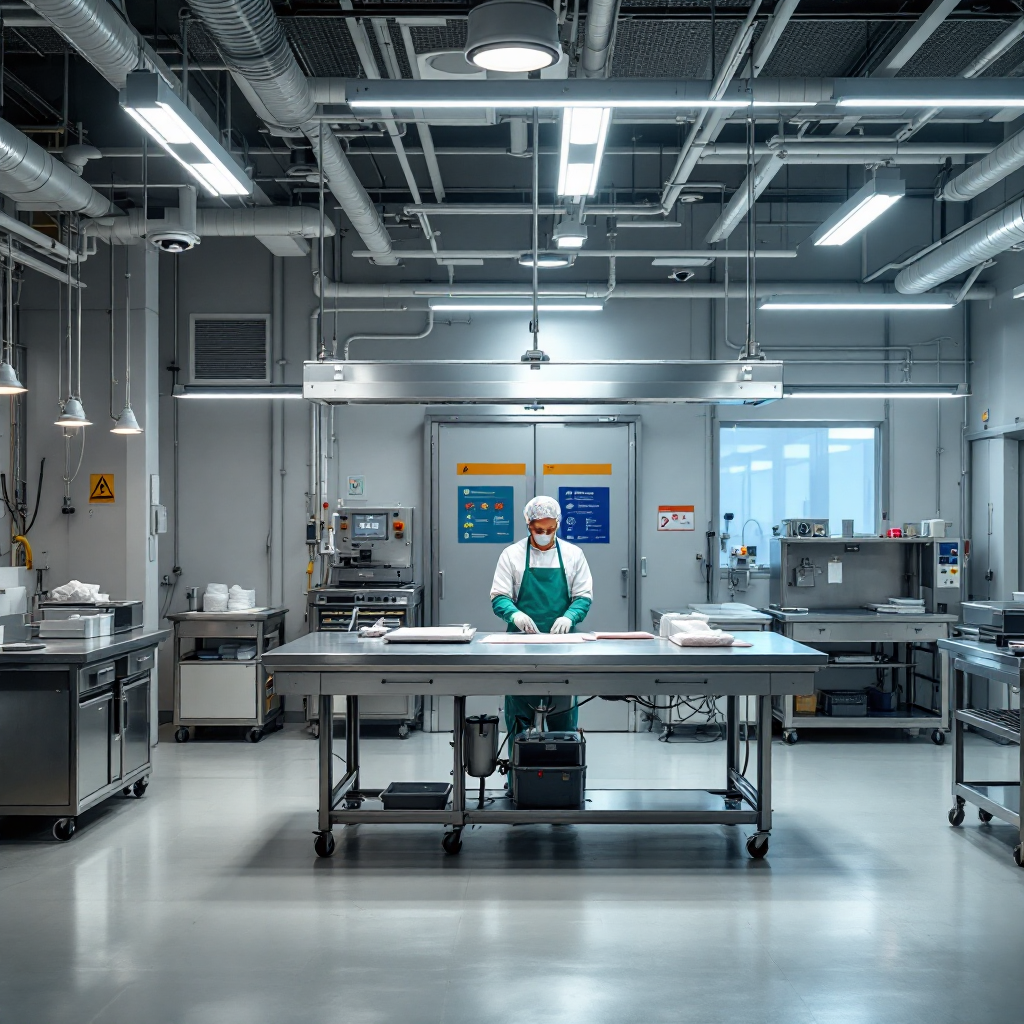
First, the boning room is the core area where knives and skilled hands intersect. Workers perform several PROCESSING TASKS such as breaking down carcass into PRIMAL CUTS, trimming fat, and preparing cut meat for packaging. These steps require precise movements and desired cut control, so the risk of the knife approaching a hand is constant. Also, environmental factors like wet floors and variable lighting complicate vision performance.
Sensor placement matters. Cameras are best mounted overhead and angled to capture the worker’s hands and the cutting plane. Proximity SENSORs can be embedded in knife handles or attached knife guards. A combination of ceiling cameras and small proximity tags creates redundancy so the DETECTION SYSTEM can pick up both visual and non-visual cues. For example, a robot arm used for repetitive lifts should be monitored with separate sensors and a ROBOTIC SYSTEM so it does not interfere with human knife work.
AI models predict unsafe movements before accidents occur. Machine learning algorithms ingest sequences of frames and small bursts of sensor readings. Then the models estimate cutting trajectories and flag when a KNIFE IS APPROACHING a hand. In addition, a simple threshold or a more advanced neural network can trigger an alert and a brief line pause. This is contact detection that emphasises time-to-intervention rather than only post-event analysis.
Also important is integration with existing workflows and equipment. Teams should test a proof of concept on a single station first, then extend coverage. For instance, Visionplatform.ai helps plants reuse existing CCTV to build a private model, which reduces the need for new hardware while preserving data ownership. This approach speeds adoption and lowers disruption. Finally, training for staff should show how alerts work, how to respond, and how the system will evolve to reduce false positives over time. This builds trust and ensures the technology aids, not interrupts, skilled work.
across the meat Plant: Data Fusion and Alerts
First, full plant coverage is achieved with a sensor network that spans boning rooms, trimming tables, and packing areas. Cameras, proximity tags, and motion SENSORs can be mapped across the floor so events flow into a central analytics engine. This site-wide map enables the system to correlate activity across stations and shifts. Also, when one station reports a pattern of near-misses, the central view can show whether the issue is local or systemic.
Data fusion combines VISION SYSTEM inputs with other sensing technologies. For example, video can identify a hand in frame while a proximity tag on a knife confirms distance. Combining these signals reduces false positives and increases confidence in an alert. Also, SENSOR DATA can include vibration or force feedback readings in advanced setups. That combination makes contact detection more robust than vision-only systems.
Alerts are tiered. First, local visual cues can warn the worker with lights or haptic feedback on the knife handle. Next, audible alarms and supervisor notifications escalate repeat events. Finally, automatic line pauses or slow-down commands can be sent to the control system if an imminent collision is detected. This multi-layered approach keeps disruption minimal while prioritising safety.
Integration with operations is key. For example, structured event streams can be published over MQTT to feed dashboards and SCADA. Companies can then use the events for process anomaly detection and to link safety events to OEE metrics. For more on how video can be used operationally beyond security, see our guide to process anomaly detection process anomaly detection. Also, using people detection concepts from other domains helps; learn how people detection is applied in different environments people detection. Finally, PPE monitoring integration can ensure gloves and cut-resistant sleeves are in use PPE detection.

AI vision within minutes?
With our no-code platform you can just focus on your data, we’ll do the rest
Overcoming Challenges in Deployment
First, data quality and diversity are essential to reduce false alarms. AI models need examples of many knife types, different knife blades, and variable lighting conditions so they generalise well. Also, a dataset must include varied CARCASS sizes and meat samples from multiple suppliers to reflect real operations. A poor dataset yields models that misfire, which erodes worker confidence.
Second, integration into legacy processing lines can be complex. Retrofitting cameras and sensors requires careful planning so that new cabling or edge devices do not disrupt hygiene zones. Also, integrating alarms into PLCs and the control system needs engineering time. Therefore, a phased rollout that starts with a proof of concept on one line reduces risk. A proof of concept can validate that the system can detect when a KNIFE IS APPROACHING a hand and then trigger a brief STOP action.
Third, worker acceptance is crucial. Training must be practical and brief. Also, workers should understand why the system alerts and how to respond. Use real demonstrations and short coaching sessions. For sustained trust, provide a feedback loop so workers can report false positives and help retrain models. Visionplatform.ai supports this approach by allowing models to be tuned on-site using local video, which keeps data private and makes retraining fast.
Finally, technical hurdles include maintaining models and reducing false positives. Solutions include modular model strategies, routine dataset updates, and combining vision with proximity sensing. Also, hardware resilience matters: cameras and edge servers must be rated for wet and cold environments. In the long run, these practices lead to a robust AI solution that fits into efficient automation and supports safer work.
Future Directions and ROI
First, future advances will improve sensor accuracy and lower false positives. Better neural network designs and lightweight models running on edge devices will give faster inference. Also, combining force feedback from some cutting tools with vision will give richer situational awareness. This supports smarter, predictive alerts so a supervisor can intervene before an incident occurs.
Second, ROI is measurable. Reducing knife-related injuries by up to 40% in pilots translates to fewer lost workdays, lower insurance claims, and higher productivity. For processors, lower incident rates often mean better throughput and less overtime. In addition, improved product quality and fewer reworks help protect product quality and safety, which benefits the entire supply chain. These gains offset initial investment in sensors and AI software over a predictable payback period.
Third, scaling rollouts across multiple plants becomes easier once a standard deployment template exists. Start with one PROCESSING PLANT, validate the model on local footage, then scale to other sites using a repeatable edge deployment. Also, integrating with broader automation and ROBOTIC technologies means the plant can automate repetitive cuts, while AI watches for human interaction points. For example, a robot was programmed to perform basic trimming while humans handle the more complex desired cut tasks.
Finally, research will explore predictive maintenance and deeper analytics. AI solutions can identify trends that signal tool wear or worker fatigue. Also, better use of SENSOR DATA will support scheduling and training interventions. In the red meat processing industry, this leads to safer lines and more consistent meat production. In sum, investment in knife zone safety delivers direct benefits to labour, product quality and safety, and the long-term resilience of the meat processing sector.
FAQ
What is AI knife zone safety detection?
AI knife zone safety detection is a system that uses cameras and sensors plus AI models to monitor knife positions relative to workers. It detects unsafe interactions and issues alerts or pauses the line to prevent injury.
How fast must the system respond to be effective?
Real-time response is required for effective prevention, often with latencies measured in tens of milliseconds. Some pilots achieve under 50 milliseconds to enable immediate alerts and automatic stops.
Can existing CCTV be used for knife zone detection?
Yes. Using existing CCTV can reduce hardware costs and keep data on-premise for compliance. Visionplatform.ai specialises in turning CCTV into an operational sensor network for this purpose.
Do these systems reduce injury rates?
Pilot studies have shown injury reductions up to 40% in large plants. These outcomes come from faster interventions and improved training driven by analytics.
How do companies handle false alarms?
Teams reduce false alarms by fusing vision with proximity SENSORs and by retraining models on local video. Operator feedback and iterative tuning are also used to improve accuracy.
Will workers accept AI alerts?
Acceptance improves with clear training, transparent performance data, and the ability for workers to flag false positives. Showing that alerts prevent real risk builds trust over time.
Does the system affect product quality?
Yes. By preventing accidents and reducing rework, the system supports product quality and safety. Analytics can also surface patterns that improve cutting consistency.
Can the system integrate with plant automation?
Yes. Alerts can be published to control systems, allowing for automatic line pauses, or to feed dashboards for operational decisions. Integration helps tie safety to productivity metrics.
Is data kept private with these systems?
On-prem and edge deployments keep video and models local, which supports privacy and regulatory compliance. This approach limits data exposure while enabling model retraining on-site.
What first steps should a processor take to adopt this technology?
Start with a proof of concept at a single boning room workstation to validate detection and workflow integration. Then scale to other lines while maintaining on-site model training and worker engagement.